NCERT Class 12 Biology • Chapter 2

Human Reproduction

📄 Source PDF: lebo102.pdf

Read it line by line. Each line is explained as if you are 10, then 5 NEET-style questions follow. Every diagram from the NCERT chapter is included. The end has Exceptions, Scientists, Examples, Exercises and High-Yield Points.

2.1

The Male Reproductive System

1

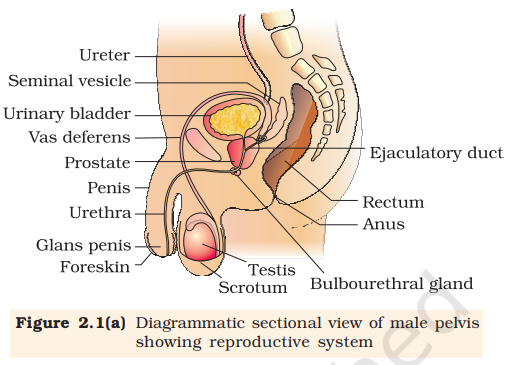
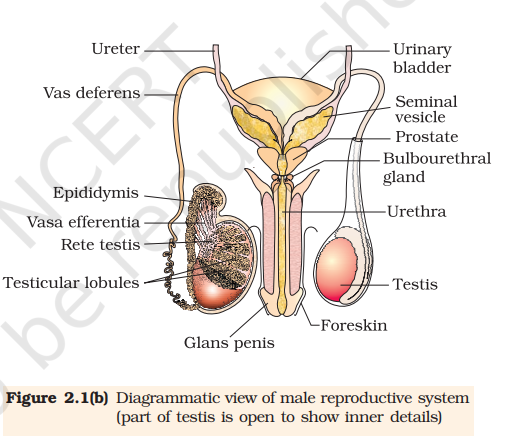
“The male reproductive system lies in the pelvis and includes a pair of testes along with accessory ducts, glands and the external genitalia.”

Figure 2.1(a) Sectional view of male pelvis
Figure 2.1(b) Male reproductive system
🧒 Explain like I’m 10

The 'boy parts' sit in the lower tummy area. The main organs are two testes, plus tubes, glands and the outside parts that help make and deliver sperm.

❓ 11 NEET-style questions to master this line
  1. Where is the male reproductive system located?
    Show answerIn the pelvic region.
  2. Name the primary sex organ in males.
    Show answerThe testes (a pair).
  3. Apart from testes, name the components of the male system.
    Show answerAccessory ducts, glands and external genitalia.
  4. Humans are sexually reproducing and ____.
    Show answerViviparous.
  5. The male external genitalia is the ____.
    Show answerPenis.
  6. Which scientific term refers to the live-bearing nature of humans?
    Show answerViviparity (viviparous).
  7. Are the testes primary or secondary sex organs in males?
    Show answerPrimary sex organs.
  8. Name two accessory ducts in the male reproductive system.
    Show answerVas deferens and epididymis.
  9. List three accessory glands of the male reproductive system.
    Show answerSeminal vesicle, prostate, bulbourethral (Cowper's) gland.
  10. Is the urethra shared between excretory and reproductive systems in males?
    Show answerYes — it carries both urine and semen.
  11. What region of the body contains the male internal reproductive organs?
    Show answerPelvic region.
2

“The testes lie outside the abdomen in a pouch called the scrotum, which keeps them 2–2.5°C below body temperature — essential for spermatogenesis. Each testis (~4–5 cm) has about 250 testicular lobules.”

🧒 Explain like I’m 10

The testes hang outside the body in a bag (scrotum) so they stay a little cooler than the body. That coolness is needed to make healthy sperm. Each testis has about 250 little rooms (lobules).

❓ 11 NEET-style questions to master this line
  1. The scrotum keeps the testes at what temperature relative to the body?
    Show answer2–2.5°C lower than internal body temperature.
  2. Why must the testes stay cooler than the body?
    Show answerThe low temperature is necessary for spermatogenesis.
  3. How many testicular lobules are present in each testis?
    Show answerAbout 250.
  4. The pouch that holds the testes is the ____.
    Show answerScrotum.
  5. Approximate length of an adult testis?
    Show answerAbout 4–5 cm.
  6. Why is the scrotum located outside the abdominal cavity?
    Show answerTo maintain a temperature about 2–2.5°C lower than body temperature, essential for spermatogenesis.
  7. Number of testes in an adult male?
    Show answerTwo (a pair).
  8. Failure of the testes to descend into the scrotum is called?
    Show answerCryptorchidism.
  9. Approximate weight of one adult testis?
    Show answerAbout 10–15 g.
  10. Which muscle helps regulate testicular temperature by altering scrotal position?
    Show answerCremaster muscle (also the dartos muscle).
  11. Each testicular lobule contains how many seminiferous tubules?
    Show answer1 to 3 highly coiled seminiferous tubules.
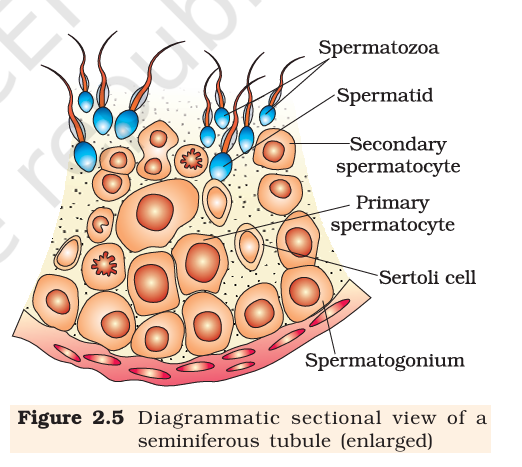
3

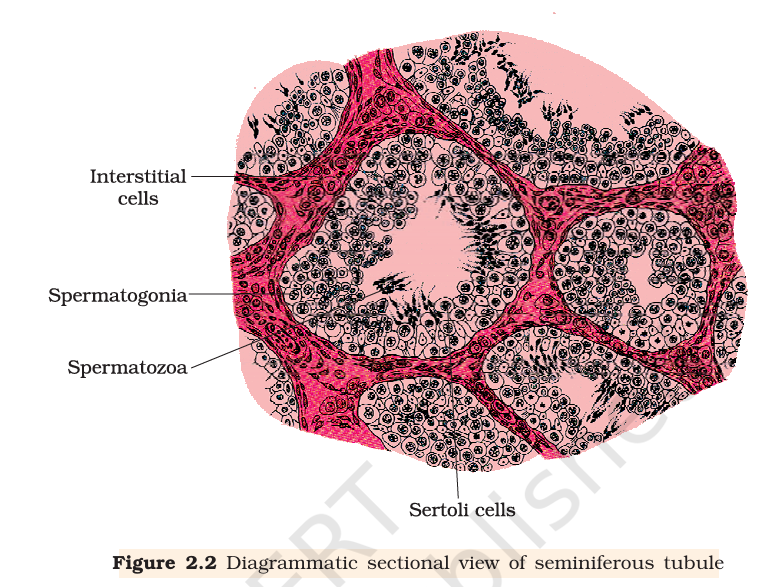
“Each lobule has 1–3 coiled seminiferous tubules lined by male germ cells (spermatogonia) and Sertoli cells (which nourish germ cells). Outside the tubules, interstitial Leydig cells secrete androgens.”

Figure 2.2 Sectional view of seminiferous tubule
🧒 Explain like I’m 10

Inside each room are coiled tubes (seminiferous tubules) where sperm are born. Sertoli cells act like 'nurses' feeding the baby sperm. Between the tubes, Leydig cells make the male hormone (androgen).

❓ 11 NEET-style questions to master this line
  1. Sperms are produced in which structures?
    Show answerSeminiferous tubules.
  2. Which cells nourish the developing germ cells?
    Show answerSertoli cells.
  3. Which cells secrete androgens?
    Show answerLeydig (interstitial) cells.
  4. Leydig cells are located ____ the seminiferous tubules.
    Show answerOutside (in interstitial spaces).
  5. Name the two cell types lining the seminiferous tubule.
    Show answerSpermatogonia (germ cells) and Sertoli cells.
  6. What are Sertoli cells also called?
    Show answerSustentacular / nurse cells.
  7. Spermatogonia are diploid or haploid?
    Show answerDiploid (2n = 46).
  8. Where exactly are Leydig cells located?
    Show answerIn the interstitial tissue between seminiferous tubules.
  9. Primary androgen secreted by Leydig cells?
    Show answerTestosterone.
  10. Which cells form the blood-testis barrier?
    Show answerSertoli cells (via tight junctions).
  11. Which hormone targets Sertoli cells to support spermatogenesis?
    Show answerFSH (follicle-stimulating hormone).
4

“Sperm travel through male accessory ducts: rete testis → vasa efferentia → epididymis → vas deferens → ejaculatory duct → urethra → urethral meatus.”

🧒 Explain like I’m 10

After they're made, sperm move along a pipeline of tubes — from the testis through several ducts and finally out through the urethra at the tip of the penis.

❓ 11 NEET-style questions to master this line
  1. Arrange the male ducts in order of sperm passage.
    Show answerRete testis → vasa efferentia → epididymis → vas deferens → ejaculatory duct → urethra.
  2. The epididymis lies along which surface of the testis?
    Show answerPosterior surface.
  3. The vas deferens receives a duct from the seminal vesicle and opens into the urethra as the ____.
    Show answerEjaculatory duct.
  4. The external opening of the urethra is the ____.
    Show answerUrethral meatus.
  5. Which duct connects the seminiferous tubules to the vasa efferentia?
    Show answerRete testis.
  6. Where do sperms mature and gain motility?
    Show answerIn the epididymis.
  7. What is the function of the vas deferens?
    Show answerConducts sperm from the epididymis to the ejaculatory duct.
  8. Surgical cutting of the vas deferens is called?
    Show answerVasectomy (male sterilisation).
  9. What forms the ejaculatory duct?
    Show answerUnion of the vas deferens with the duct of the seminal vesicle.
  10. Through which structure does sperm finally leave the body?
    Show answerUrethra (via the urethral meatus on the penis).
  11. Vasa efferentia connect the rete testis to which structure?
    Show answerThe epididymis.
5

“Male accessory glands are paired seminal vesicles, a prostate, and paired bulbourethral glands; their secretions form the seminal plasma, rich in fructose, calcium and enzymes.”

🧒 Explain like I’m 10

Three sets of glands add fluid to the sperm. This fluid (seminal plasma) carries sugar (fructose) for energy, calcium and special enzymes.

❓ 11 NEET-style questions to master this line
  1. Name the male accessory glands.
    Show answerSeminal vesicles, prostate and bulbourethral glands.
  2. Seminal plasma is rich in ____.
    Show answerFructose, calcium and certain enzymes.
  3. Which gland's secretion also lubricates the penis?
    Show answerBulbourethral glands.
  4. Seminal plasma + sperms together form the ____.
    Show answerSemen.
  5. The enlarged end of the penis is the ____, covered by the foreskin.
    Show answerGlans penis.
  6. Number of seminal vesicles in an adult male?
    Show answerOne pair (two).
  7. Number of prostate glands?
    Show answerOne (unpaired).
  8. Number of bulbourethral (Cowper's) glands?
    Show answerOne pair (two).
  9. Why is fructose present in seminal plasma?
    Show answerTo provide energy for sperm motility.
  10. Approximate volume of one ejaculate?
    Show answer2–5 mL containing 200–300 million sperms.
  11. Which gland's secretion is the major contributor to seminal volume?
    Show answerThe seminal vesicles (~60–70%).
2.2

The Female Reproductive System

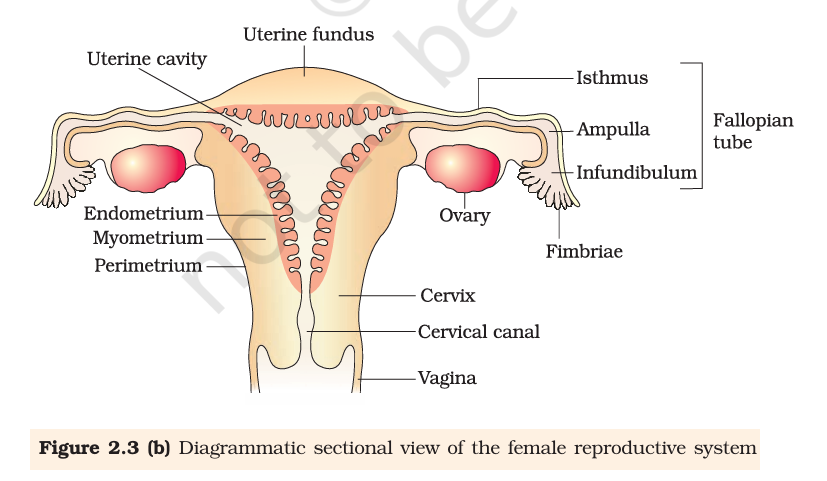
6

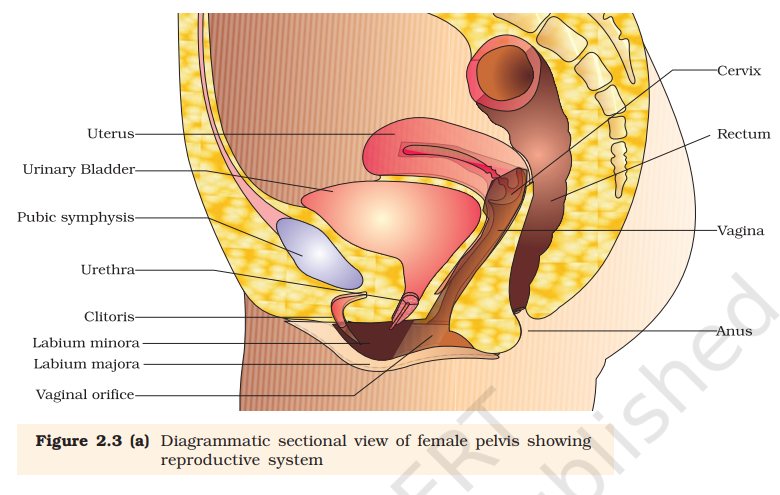
“The female system has a pair of ovaries with a pair of oviducts, the uterus, cervix, vagina, external genitalia, and a pair of mammary glands.”

Figure 2.3(a) Sectional view of female pelvis
Figure 2.3(b) Female reproductive system
🧒 Explain like I’m 10

The 'girl parts' include two ovaries, two egg tubes, the womb, the birth passage, the outside parts, and the breasts that make milk.

❓ 11 NEET-style questions to master this line
  1. Name the primary female sex organs.
    Show answerOvaries (a pair).
  2. Name the female accessory ducts.
    Show answerOviducts (fallopian tubes), uterus and vagina.
  3. The mammary glands are a ____ sexual characteristic of females.
    Show answerSecondary.
  4. Which structures support ovulation, fertilisation, pregnancy and child care?
    Show answerOvaries, oviducts, uterus, cervix, vagina, external genitalia and mammary glands.
  5. How many ovaries and oviducts are present?
    Show answerA pair of each (two).
  6. What is the primary sex organ in females?
    Show answerThe ovaries (pair).
  7. Are oviducts called fallopian tubes?
    Show answerYes — they are also known as fallopian tubes.
  8. Number of mammary glands in females?
    Show answerOne pair.
  9. Which female structure connects the uterus to the vagina?
    Show answerCervix (cervical canal).
  10. Define the birth canal.
    Show answerThe cervical canal plus vagina together form the birth canal.
  11. Are mammary glands accessory or primary reproductive organs?
    Show answerAccessory (secondary).
7

“Ovaries (~2–4 cm) are the primary sex organs producing the ovum and ovarian (steroid) hormones; the ovarian stroma is divided into a peripheral cortex and an inner medulla.”

🧒 Explain like I’m 10

Each ovary is small (2–4 cm). It makes the egg and female hormones. Inside, it has an outer layer (cortex) and an inner core (medulla).

❓ 11 NEET-style questions to master this line
  1. Ovaries produce the female gamete and ____.
    Show answerOvarian (steroid) hormones.
  2. The ovarian stroma is divided into ____ and ____.
    Show answerPeripheral cortex and inner medulla.
  3. Approximate length of an ovary?
    Show answer2–4 cm.
  4. The female gamete produced by the ovary is the ____.
    Show answerOvum.
  5. Ovaries are connected to the pelvic wall and uterus by ____.
    Show answerLigaments.
  6. Where are the ovaries located in the abdominal cavity?
    Show answerIn the lower abdomen, one on each side of the uterus.
  7. Name two ovarian (steroid) hormones.
    Show answerEstrogen and progesterone.
  8. What is the ovarian stroma divided into?
    Show answerOuter cortex and inner medulla.
  9. Length of an adult ovary?
    Show answerApproximately 2–4 cm.
  10. By what ligament are the ovaries attached to the pelvic wall?
    Show answerLigament of the ovary (and broad ligament).
  11. From which embryonic germ layer do ovaries develop?
    Show answerMesoderm.
8

“Each oviduct (10–12 cm) runs from the ovary to the uterus: the funnel-shaped infundibulum (with fimbriae that collect the ovum) → ampulla → isthmus → uterus.”

🧒 Explain like I’m 10

The egg tube is about 10–12 cm long. Its mouth (infundibulum) has finger-like fringes (fimbriae) that catch the released egg. Then comes a wide part (ampulla) and a narrow part (isthmus).

❓ 11 NEET-style questions to master this line
  1. Length of a fallopian tube?
    Show answer10–12 cm.
  2. Finger-like projections that collect the ovum are the ____.
    Show answerFimbriae.
  3. The funnel-shaped part of the oviduct is the ____.
    Show answerInfundibulum.
  4. The wider part of the oviduct, where fertilisation occurs, is the ____.
    Show answerAmpulla.
  5. The narrow part of the oviduct that joins the uterus is the ____.
    Show answerIsthmus.
  6. Approximate length of each fallopian tube?
    Show answerAbout 10–12 cm.
  7. Sequence of oviduct regions from ovary to uterus?
    Show answerInfundibulum → ampulla → isthmus → uterus.
  8. What are fimbriae?
    Show answerFinger-like projections of the infundibulum that collect the released ovum.
  9. Where does fertilisation usually take place?
    Show answerIn the ampulla (specifically the ampullary-isthmic junction).
  10. Which portion of the oviduct is closest to the uterus?
    Show answerThe isthmus.
  11. What is the funnel-shaped opening of the oviduct called?
    Show answerInfundibulum.
9

“The uterus (womb) is inverted-pear-shaped with three wall layers: outer perimetrium, middle muscular myometrium, inner glandular endometrium. The cervical canal + vagina form the birth canal.”

🧒 Explain like I’m 10

The womb looks like an upside-down pear. Its wall has 3 layers: a thin outer cover, a thick muscle layer (that pushes the baby out), and an inner lining that changes each month.

❓ 11 NEET-style questions to master this line
  1. Name the three layers of the uterine wall.
    Show answerPerimetrium, myometrium, endometrium.
  2. Which uterine layer undergoes cyclical changes during the menstrual cycle?
    Show answerEndometrium.
  3. Which layer shows strong contractions during delivery?
    Show answerMyometrium.
  4. The cervical canal and vagina together form the ____.
    Show answerBirth canal.
  5. The uterus opens into the vagina through the ____.
    Show answerCervix.
  6. What is the shape of the uterus?
    Show answerInverted pear-shaped.
  7. Which layer of the uterus undergoes monthly changes?
    Show answerThe endometrium (innermost glandular layer).
  8. Which layer is responsible for labour contractions?
    Show answerThe myometrium (thick muscular layer).
  9. The outermost serous layer of the uterus is the?
    Show answerPerimetrium.
  10. What does the cervix open into?
    Show answerThe vagina (via the cervical canal).
  11. During pregnancy, in which uterine layer does the embryo embed?
    Show answerEndometrium.
10

“Female external genitalia: mons pubis, labia majora, labia minora, hymen and clitoris. The presence or absence of the hymen is NOT a reliable indicator of virginity or sexual experience.”

🧒 Explain like I’m 10

The outside female parts include fatty/skin folds and a small membrane called the hymen. Importantly, the hymen can break in many normal ways, so it does not tell whether someone is a virgin.

❓ 11 NEET-style questions to master this line
  1. Name the parts of the female external genitalia.
    Show answerMons pubis, labia majora, labia minora, hymen, clitoris.
  2. Is the hymen a reliable indicator of virginity?
    Show answerNo — it is not reliable.
  3. The membrane partially covering the vaginal opening is the ____.
    Show answerHymen.
  4. The tiny finger-like structure above the urethral opening is the ____.
    Show answerClitoris.
  5. Mons pubis is a cushion of ____ tissue.
    Show answerFatty.
  6. List the components of the female external genitalia.
    Show answerMons pubis, labia majora, labia minora, hymen, clitoris.
  7. What is the hymen?
    Show answerA thin membrane partially covering the vaginal opening; may be torn by various non-sexual causes.
  8. Which structure of the female external genitalia is most analogous to the male penis?
    Show answerClitoris (erectile tissue, dense nerve supply).
  9. What is the mons pubis?
    Show answerFatty cushion of tissue covering the pubic symphysis, covered with skin and pubic hair after puberty.
  10. The labia majora is covered with hair after puberty — true or false?
    Show answerTrue.
  11. Is the hymen a reliable indicator of virginity?
    Show answerNo — its presence or absence is not a reliable indicator of virginity or sexual experience.
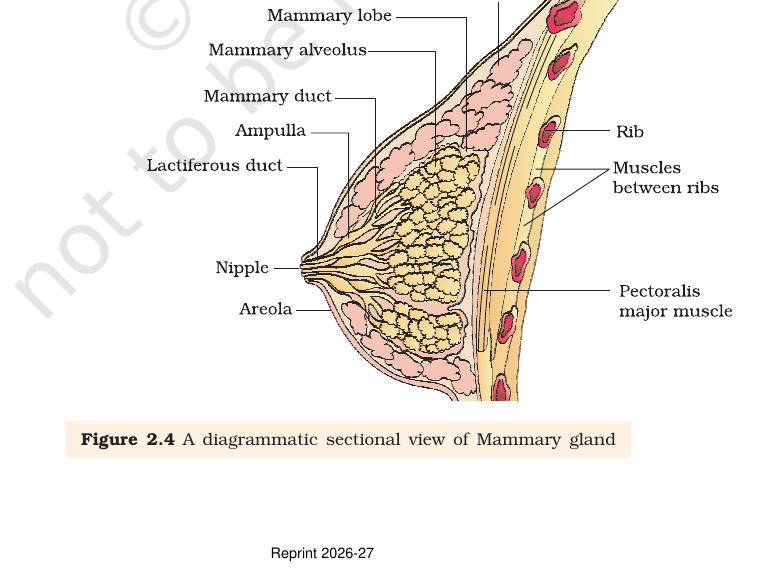
11

“Each mammary gland has 15–20 mammary lobes with clusters of cells (alveoli) that secrete milk. Milk flows: alveoli → mammary tubules → mammary duct → mammary ampulla → lactiferous duct → nipple.”

Figure 2.4 Sectional view of mammary gland
🧒 Explain like I’m 10

The breast has 15–20 sections, each full of tiny milk-making sacs (alveoli). Milk travels through small tubes that join into bigger ducts and finally comes out at the nipple.

❓ 11 NEET-style questions to master this line
  1. How many mammary lobes are in each breast?
    Show answer15–20.
  2. Milk is secreted by which cells?
    Show answerCells of the alveoli.
  3. Trace the path of milk from alveoli to nipple.
    Show answerAlveoli → mammary tubules → mammary duct → ampulla → lactiferous duct → nipple.
  4. Milk is stored in the cavities (lumens) of the ____.
    Show answerAlveoli.
  5. A functional mammary gland is characteristic of all female ____.
    Show answerMammals.
  6. Number of mammary lobes in each breast?
    Show answer15–20 lobes.
  7. What are mammary alveoli?
    Show answerClusters of cells inside lobes that secrete milk.
  8. Sequence of milk flow within the mammary gland.
    Show answerAlveoli → mammary tubules → mammary duct → mammary ampulla → lactiferous duct → nipple.
  9. Are mammary glands modified sweat glands?
    Show answerYes — they are modified apocrine sweat glands.
  10. Which hormone primarily stimulates milk production?
    Show answerProlactin (from anterior pituitary).
  11. Which hormone causes milk ejection (let-down)?
    Show answerOxytocin (from posterior pituitary).
2.3

Gametogenesis

12

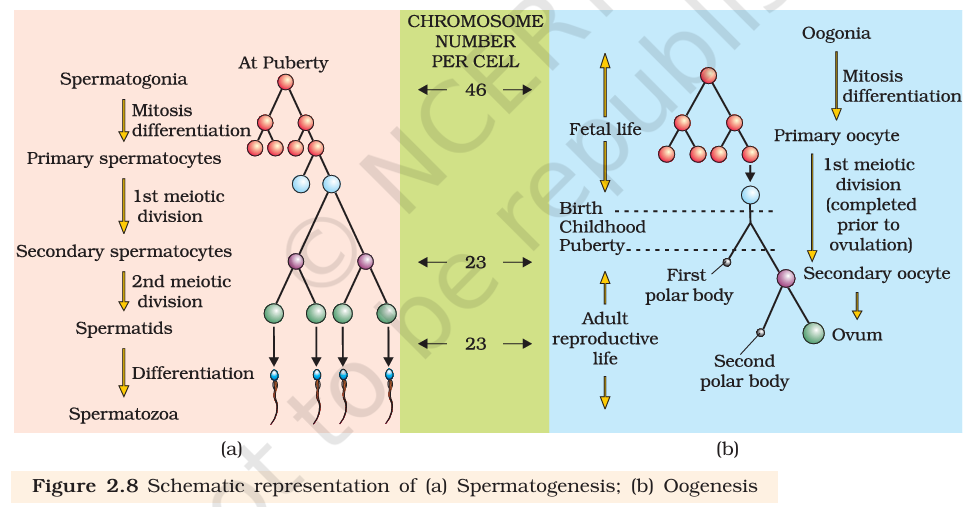
“Spermatogenesis begins at puberty: diploid spermatogonia (46 chromosomes) multiply by mitosis; some become primary spermatocytes that undergo meiosis I to give two haploid secondary spermatocytes (23 each).”

🧒 Explain like I’m 10

Sperm-making starts at puberty. Baby sperm cells (46 chromosomes) first multiply, then one type splits (meiosis I) into two cells with half the chromosomes (23).

❓ 11 NEET-style questions to master this line
  1. Spermatogenesis begins at the age of ____.
    Show answerPuberty.
  2. How many chromosomes does a spermatogonium have?
    Show answer46 (diploid).
  3. Meiosis I of a primary spermatocyte gives ____.
    Show answerTwo haploid secondary spermatocytes (23 each).
  4. Spermatogonia multiply by which division?
    Show answerMitosis.
  5. How many chromosomes in a secondary spermatocyte?
    Show answer23.
  6. When does spermatogenesis begin?
    Show answerAt puberty.
  7. Number of chromosomes in a spermatogonium?
    Show answer46 (diploid).
  8. What is the chromosome number of a primary spermatocyte?
    Show answer46 (diploid).
  9. Number of chromosomes in a secondary spermatocyte?
    Show answer23 (haploid).
  10. Which division converts a primary spermatocyte to secondary spermatocytes?
    Show answerMeiosis I (reduction division).
  11. How many secondary spermatocytes come from one primary spermatocyte?
    Show answerTwo.
13

“Secondary spermatocytes undergo meiosis II to form four haploid spermatids; spermatids transform into sperms by spermiogenesis, and sperms are released from the seminiferous tubules by spermiation.”

Figure 2.5 Enlarged seminiferous tubule (spermatogenesis)
🧒 Explain like I’m 10

Each of those two cells splits again into two, making four spermatids. The spermatids then change shape into proper sperm (spermiogenesis) and are let go from the tube (spermiation).

❓ 11 NEET-style questions to master this line
  1. Meiosis II produces how many spermatids per primary spermatocyte?
    Show answerFour.
  2. Transformation of spermatids into sperms is called ____.
    Show answerSpermiogenesis.
  3. Release of sperms from the seminiferous tubules is called ____.
    Show answerSpermiation.
  4. Ploidy of a spermatid?
    Show answerHaploid (23).
  5. After spermiogenesis, sperm heads become embedded in which cells?
    Show answerSertoli cells.
  6. How many spermatids result from one primary spermatocyte?
    Show answerFour.
  7. What is spermiogenesis?
    Show answerTransformation of non-motile spermatids into motile sperms.
  8. What is spermiation?
    Show answerRelease of mature sperms from the seminiferous tubules into the lumen.
  9. Number of chromosomes in a spermatid?
    Show answer23 (haploid).
  10. Which meiotic division gives spermatids from secondary spermatocytes?
    Show answerMeiosis II.
  11. Approximate time required for spermatogenesis in humans?
    Show answerAbout 64–72 days (commonly cited as ~64 days).
14

“Spermatogenesis is hormone-controlled: GnRH (hypothalamus) → FSH & LH from the anterior pituitary. LH acts on Leydig cells to secrete androgens (drive spermatogenesis); FSH acts on Sertoli cells (aid spermiogenesis).”

🧒 Explain like I’m 10

The brain sends a signal (GnRH) to the pituitary gland, which releases two hormones (FSH and LH). LH tells Leydig cells to make androgen, and FSH tells Sertoli cells to help sperm mature.

❓ 11 NEET-style questions to master this line
  1. Which hypothalamic hormone initiates spermatogenesis at puberty?
    Show answerGnRH (gonadotropin releasing hormone).
  2. GnRH stimulates the anterior pituitary to secrete ____.
    Show answerLH and FSH.
  3. LH acts on which cells?
    Show answerLeydig cells (→ androgens).
  4. FSH acts on which cells?
    Show answerSertoli cells.
  5. Androgens stimulate the process of ____.
    Show answerSpermatogenesis.
  6. Source of GnRH?
    Show answerHypothalamus.
  7. Which gland secretes FSH and LH?
    Show answerAnterior pituitary.
  8. On which cells does LH act in males?
    Show answerLeydig (interstitial) cells.
  9. On which cells does FSH act in males?
    Show answerSertoli cells.
  10. Which androgen drives male secondary sexual characters?
    Show answerTestosterone.
  11. Negative feedback for FSH is provided by which Sertoli product?
    Show answerInhibin.
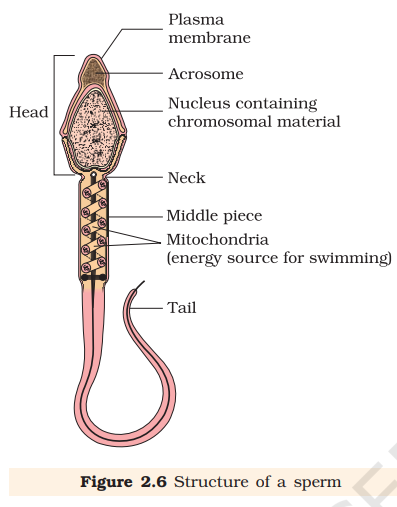
15

“A sperm has a head (haploid nucleus + acrosome with fertilising enzymes), neck, middle piece (many mitochondria for energy) and a tail (motility). A man ejaculates 200–300 million sperms; ≥60% must be normal-shaped and ≥40% motile for normal fertility.”

Figure 2.6 Structure of a sperm
🧒 Explain like I’m 10

A sperm looks like a tadpole: a head carrying the DNA and an enzyme cap (acrosome), a middle full of 'batteries' (mitochondria) for energy, and a tail to swim. Millions are released, but they must be mostly healthy and good swimmers.

❓ 11 NEET-style questions to master this line
  1. Name the four parts of a sperm.
    Show answerHead, neck, middle piece, tail.
  2. The cap-like structure over the sperm head is the ____.
    Show answerAcrosome.
  3. Which part of the sperm contains many mitochondria?
    Show answerMiddle piece.
  4. How many sperms are ejaculated during a coitus?
    Show answer200–300 million.
  5. For normal fertility, what % of sperms must show vigorous motility?
    Show answerAt least 40% (and ≥60% normal shape).
  6. Four main parts of a human sperm?
    Show answerHead, neck, middle piece, tail.
  7. Which part of sperm contains DNA?
    Show answerHead (haploid nucleus).
  8. What does the acrosome contain?
    Show answerHydrolytic enzymes that help the sperm penetrate the ovum.
  9. Why does the middle piece have many mitochondria?
    Show answerTo supply energy (ATP) for the tail's whip-like motion.
  10. Minimum % normal-shaped sperms for normal fertility?
    Show answer60%.
  11. Minimum % motile sperms for normal fertility?
    Show answer40%.
16

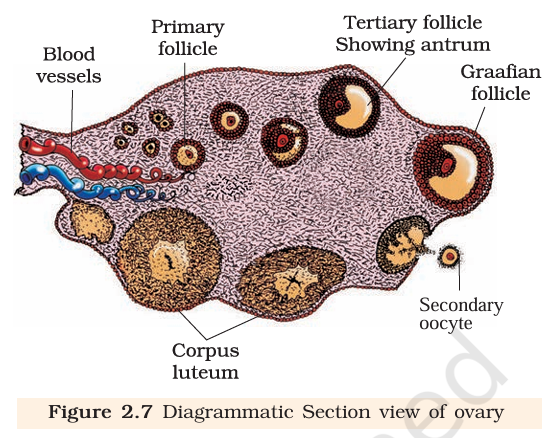
“Oogenesis begins in the embryo: a couple of million oogonia form in each fetal ovary and NO new oogonia form after birth. They enter prophase-I of meiosis and arrest as primary oocytes, each surrounded by granulosa cells (primary follicle). At puberty only 60,000–80,000 primary follicles remain per ovary.”

Figure 2.7 Sectional view of ovary
🧒 Explain like I’m 10

Egg-making starts before a girl is even born! All the egg-mother cells are made in the baby's ovary and never made again. They pause halfway through meiosis and wait. By puberty, only about 60,000–80,000 are left in each ovary.

❓ 11 NEET-style questions to master this line
  1. When does oogenesis begin?
    Show answerDuring embryonic (fetal) development.
  2. Are new oogonia formed after birth?
    Show answerNo.
  3. At what stage are primary oocytes arrested?
    Show answerProphase-I of meiosis.
  4. A primary oocyte surrounded by a layer of granulosa cells is a ____.
    Show answerPrimary follicle.
  5. How many primary follicles remain in each ovary at puberty?
    Show answer60,000–80,000.
  6. When does oogenesis begin?
    Show answerDuring embryonic development (foetal life).
  7. Are new oogonia formed after birth?
    Show answerNo — never after birth.
  8. Approximate number of oogonia in each foetal ovary?
    Show answerA couple of million (~2 million).
  9. At what stage are primary oocytes arrested?
    Show answerAt diplotene stage of prophase-I of meiosis I.
  10. What surrounds the primary oocyte to form a primary follicle?
    Show answerA layer of granulosa cells.
  11. Approximate number of primary follicles per ovary at puberty?
    Show answer60,000 to 80,000.
17

“Follicles develop: primary → secondary (more granulosa + theca) → tertiary (fluid-filled antrum; theca interna & externa) → Graafian. In the tertiary follicle the primary oocyte completes meiosis I unequally → a large secondary oocyte + a tiny first polar body; a zona pellucida forms. The Graafian follicle ruptures (ovulation) to release the secondary oocyte.”

Figure 2.8 Spermatogenesis & Oogenesis
🧒 Explain like I’m 10

The follicle grows step by step and develops a fluid pocket (antrum). Now the egg finishes meiosis I, but unfairly — one big egg keeps almost all the food, and a tiny 'polar body' is thrown away. The ripe follicle (Graafian) then bursts to release the egg (ovulation).

❓ 11 NEET-style questions to master this line
  1. A fluid-filled cavity in the tertiary follicle is the ____.
    Show answerAntrum.
  2. The mature follicle that ruptures at ovulation is the ____.
    Show answerGraafian follicle.
  3. Meiosis I of the primary oocyte gives ____.
    Show answerA large secondary oocyte + a tiny first polar body.
  4. The new membrane around the secondary oocyte is the ____.
    Show answerZona pellucida.
  5. The theca layer organises into an inner ____ and an outer ____.
    Show answerTheca interna and theca externa.
  6. Sequence of follicle stages?
    Show answerPrimary → secondary → tertiary → Graafian follicle.
  7. What fills the antrum of a tertiary follicle?
    Show answerFollicular fluid (liquor folliculi).
  8. Two cell layers of theca?
    Show answerTheca interna and theca externa.
  9. Products of unequal meiosis-I division of primary oocyte?
    Show answerSecondary oocyte and first polar body.
  10. Name the protective glycoprotein layer around the secondary oocyte.
    Show answerZona pellucida.
  11. Name the surge of which hormone triggers ovulation?
    Show answerLH surge.
2.4

Menstrual Cycle

18

“The reproductive cycle of female primates is the menstrual cycle. The first menstruation at puberty is menarche; cycles repeat about every 28/29 days; one ovum is released mid-cycle. Cycles cease around age 50 (menopause).”

🧒 Explain like I’m 10

Only female monkeys, apes and humans have a 'menstrual cycle'. The first period is called menarche, and it happens about every 28–29 days. One egg is released in the middle. Around age 50, periods stop forever (menopause).

❓ 11 NEET-style questions to master this line
  1. The reproductive cycle of female primates is the ____.
    Show answerMenstrual cycle.
  2. The first menstruation at puberty is called ____.
    Show answerMenarche.
  3. Average length of the menstrual cycle?
    Show answer28/29 days.
  4. Cessation of menstrual cycles around age 50 is ____.
    Show answerMenopause.
  5. How many ova are released per cycle?
    Show answerOne.
  6. What is the first menstruation called?
    Show answerMenarche.
  7. Average length of a menstrual cycle?
    Show answerAbout 28/29 days.
  8. How many ova are typically released per cycle?
    Show answerOne.
  9. At what age does menopause typically occur?
    Show answerAround 50 years.
  10. What is the time around which an ovum is released?
    Show answerMid-cycle (~day 14).
  11. Menstrual cycle is characteristic of which mammals?
    Show answerPrimates (apes, monkeys, humans).
19

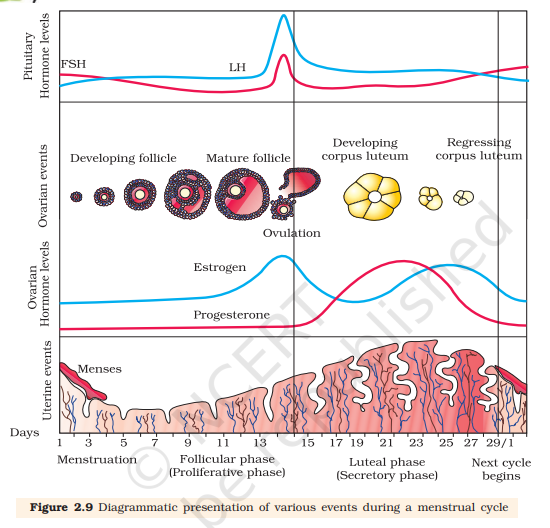
“Phases: (1) Menstrual phase (3–5 days, endometrium breaks down — occurs only if the ovum is NOT fertilised); (2) Follicular/proliferative phase (follicle matures to Graafian, endometrium regenerates; FSH/LH & estrogen rise).”

Figure 2.9 Events of the menstrual cycle
🧒 Explain like I’m 10

The cycle starts with bleeding for 3–5 days — but only if no baby started. Then the follicle grows into a ripe Graafian follicle and the womb lining rebuilds, helped by rising hormones.

❓ 11 NEET-style questions to master this line
  1. How long does the menstrual flow last?
    Show answer3–5 days.
  2. Menstruation occurs only if the ovum is ____.
    Show answerNot fertilised.
  3. Lack of menstruation may indicate ____.
    Show answerPregnancy (or stress/poor health).
  4. During the follicular phase the endometrium ____.
    Show answerRegenerates by proliferation.
  5. Which hormones rise during the follicular phase?
    Show answerFSH, LH and estrogens.
  6. Length of menstrual phase?
    Show answer3–5 days.
  7. What is shed during menstruation?
    Show answerEndometrial lining and unfertilised ovum (with some blood).
  8. Menstruation occurs only if?
    Show answerThe ovum is NOT fertilised.
  9. During follicular phase, which follicles develop?
    Show answerPrimary → secondary → tertiary → Graafian.
  10. Which two hormones rise in the follicular phase?
    Show answerFSH and estrogen.
  11. Alternative name for follicular phase of the endometrium?
    Show answerProliferative phase.
20

“LH and FSH peak mid-cycle (~14th day); the rapid LH surge triggers rupture of the Graafian follicle and ovulation. In the luteal phase the corpus luteum secretes progesterone, which maintains the endometrium for implantation; if no fertilisation, the corpus luteum degenerates → menstruation.”

🧒 Explain like I’m 10

Around day 14, a big burst of LH (the 'LH surge') pops the follicle and releases the egg. The leftover follicle becomes the corpus luteum, which makes progesterone to keep the womb lining ready. If no baby comes, it shrinks and the period begins again.

❓ 11 NEET-style questions to master this line
  1. The mid-cycle rise of LH is called the ____.
    Show answerLH surge.
  2. What does the LH surge induce?
    Show answerRupture of the Graafian follicle (ovulation).
  3. On approximately which day do LH and FSH peak?
    Show answerAbout the 14th day.
  4. The corpus luteum secretes large amounts of ____.
    Show answerProgesterone.
  5. Why does the corpus luteum degenerate in absence of fertilisation?
    Show answerLeading to endometrium breakdown and menstruation.
  6. On which day do LH and FSH peak in a 28-day cycle?
    Show answerAround day 14.
  7. What does the LH surge cause?
    Show answerRupture of the Graafian follicle (ovulation).
  8. After ovulation, what does the ruptured follicle become?
    Show answerCorpus luteum.
  9. Major hormone secreted by the corpus luteum?
    Show answerProgesterone.
  10. What happens to the corpus luteum if no fertilisation occurs?
    Show answerIt degenerates into corpus albicans → progesterone falls → menstruation.
  11. Alternative name for the luteal phase of the endometrium?
    Show answerSecretory phase.
2.5

Fertilisation & Implantation

21

“During coitus, semen is released into the vagina (insemination); motile sperms reach the ampulla of the fallopian tube, where fertilisation occurs — but only if ovum and sperms reach the ampulla simultaneously.”

🧒 Explain like I’m 10

Sperm are placed in the vagina and swim up to the wide part of the egg tube (ampulla). The egg and sperm must arrive there at the same time — that's why not every time leads to a baby.

❓ 11 NEET-style questions to master this line
  1. Release of semen into the vagina is called ____.
    Show answerInsemination.
  2. Where does fertilisation take place?
    Show answerAmpulla of the fallopian tube.
  3. Fertilisation occurs only if ovum and sperms reach the ampulla ____.
    Show answerSimultaneously.
  4. Why don't all copulations lead to pregnancy?
    Show answerOvum and sperms may not reach the ampulla at the same time.
  5. The fusion of a sperm with an ovum is called ____.
    Show answerFertilisation.
  6. What is insemination?
    Show answerRelease of semen into the female vaginal tract during coitus.
  7. Where must motile sperms reach for fertilisation?
    Show answerThe ampulla of the fallopian tube.
  8. What two requirements must coincide for fertilisation?
    Show answerOvum and sperms must reach the ampulla simultaneously.
  9. Approximately how long can sperms survive in the female tract?
    Show answerUp to 72 hours (about 3 days).
  10. How long is the secondary oocyte usually viable for fertilisation?
    Show answerAbout 24 hours after ovulation.
  11. Of the millions of sperms released, how many typically reach the oocyte?
    Show answerA few hundred only.
22

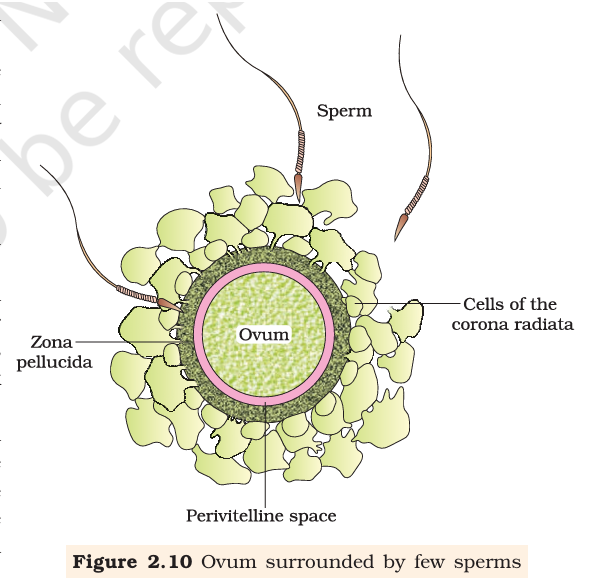
“A sperm contacts the zona pellucida and triggers changes that block the entry of other sperms (ensuring monospermy). Acrosomal enzymes help the sperm enter; this induces the ovum to complete meiosis II → a second polar body + a haploid ovum (ootid). Sperm + ovum nuclei fuse → diploid zygote.”

Figure 2.10 Ovum surrounded by sperms
🧒 Explain like I’m 10

When one sperm touches the egg's coat (zona pellucida), the egg locks the door so no other sperm gets in. The acrosome enzymes help the winner enter. This makes the egg finish its meiosis, and then the two nuclei join to form the zygote.

❓ 11 NEET-style questions to master this line
  1. Contact of a sperm with the ovum induces changes that block ____.
    Show answerEntry of additional sperms (polyspermy).
  2. Which layer of the ovum does the sperm first contact?
    Show answerZona pellucida.
  3. Acrosomal enzymes help the sperm enter through the zona pellucida and ____.
    Show answerPlasma membrane.
  4. Entry of the sperm induces completion of which division in the oocyte?
    Show answerSecond meiotic division (meiosis II).
  5. How many chromosomes are in the zygote?
    Show answer46 (diploid).
  6. What is monospermy?
    Show answerEntry of only one sperm into the ovum, blocking others.
  7. Which layer prevents polyspermy after one sperm enters?
    Show answerThe zona pellucida (cortical reaction modifies it).
  8. Which sperm enzymes help it penetrate the zona pellucida?
    Show answerAcrosomal hydrolytic enzymes (e.g., hyaluronidase, acrosin).
  9. What stage of meiosis does the sperm trigger the ovum to complete?
    Show answerMeiosis II.
  10. Products of meiosis II completion in the ovum?
    Show answerHaploid ovum (ootid) + second polar body.
  11. Final product of fusion of sperm and ovum nuclei?
    Show answerDiploid zygote (46 chromosomes).
23

“Sex is determined by the father: ova carry X; 50% of sperms carry X and 50% carry Y. An X-sperm → XX (girl); a Y-sperm → XY (boy). So blaming the mother for the baby's sex is scientifically incorrect.”

🧒 Explain like I’m 10

The egg always carries X. Half the sperm carry X and half carry Y. If an X-sperm wins, it's a girl (XX); if a Y-sperm wins, it's a boy (XY). So the father's sperm decides — not the mother!

❓ 11 NEET-style questions to master this line
  1. Which parent determines the sex of the baby?
    Show answerThe father.
  2. Chromosome pattern of a human female?
    Show answerXX.
  3. Chromosome pattern of a human male?
    Show answerXY.
  4. A sperm carrying the Y chromosome produces a ____ baby.
    Show answerMale (XY).
  5. What % of sperms carry the X chromosome?
    Show answer50%.
  6. Who determines the sex of the baby?
    Show answerThe father (via X- or Y-bearing sperm).
  7. Genetic make-up of male humans?
    Show answer44 + XY.
  8. Genetic make-up of female humans?
    Show answer44 + XX.
  9. Sex chromosome composition of all ova?
    Show answerX (all eggs are X-carriers).
  10. Percentage of sperms that carry X?
    Show answerAbout 50%.
  11. Is XY mechanism specific to mammals?
    Show answerIt is the typical mammalian sex-determination system; XX/XO and ZW are found in insects and birds.
24

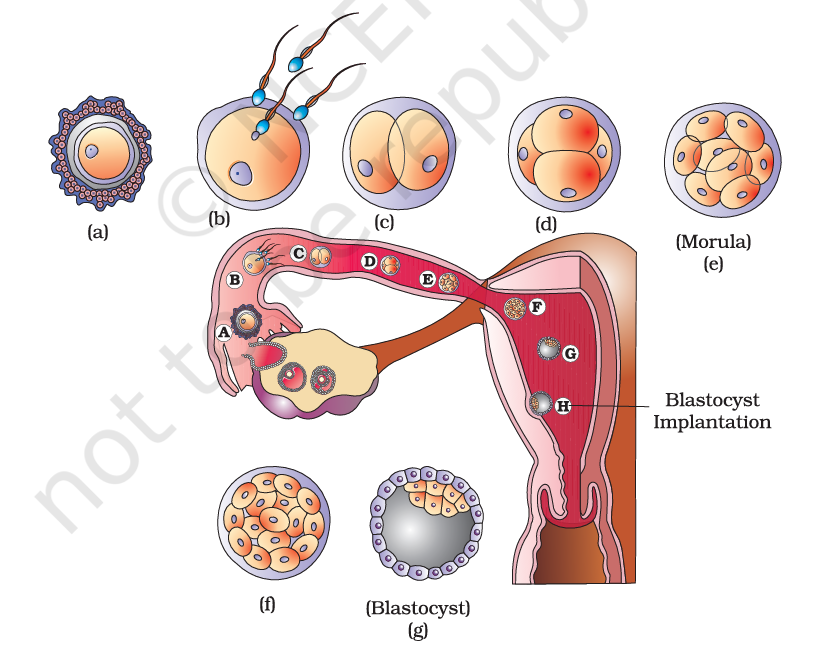
“As the zygote moves through the isthmus toward the uterus it undergoes cleavage forming 2, 4, 8, 16 blastomeres; 8–16 blastomeres = morula → blastocyst (outer trophoblast + inner cell mass). The trophoblast attaches to the endometrium and the blastocyst becomes embedded — implantation → pregnancy.”

Figure 2.11 Transport of ovum, fertilisation & embryo passage
🧒 Explain like I’m 10

The zygote keeps dividing as it travels: 2, 4, 8, 16 cells. The ball of 8–16 cells is a morula, which becomes a blastocyst (an outer shell + an inner cell clump). The blastocyst then buries itself in the womb lining — that's implantation, the start of pregnancy.

❓ 11 NEET-style questions to master this line
  1. Repeated mitotic division of the zygote is called ____.
    Show answerCleavage.
  2. The cells formed by cleavage are called ____.
    Show answerBlastomeres.
  3. An embryo with 8–16 blastomeres is called a ____.
    Show answerMorula.
  4. The blastocyst has an outer ____ and an inner cell mass.
    Show answerTrophoblast.
  5. Embedding of the blastocyst in the endometrium is called ____.
    Show answerImplantation.
  6. What is cleavage?
    Show answerRapid mitotic divisions of the zygote without growth in cell size.
  7. How many cells make up a morula?
    Show answer8 to 16 blastomeres.
  8. Name the two parts of a blastocyst.
    Show answerTrophoblast (outer) and inner cell mass.
  9. Which part of the blastocyst forms the embryo proper?
    Show answerInner cell mass.
  10. Where does the blastocyst implant?
    Show answerIn the uterine endometrium.
  11. Pregnancy is said to begin at which event?
    Show answerImplantation.
2.6

Pregnancy & Embryonic Development

25

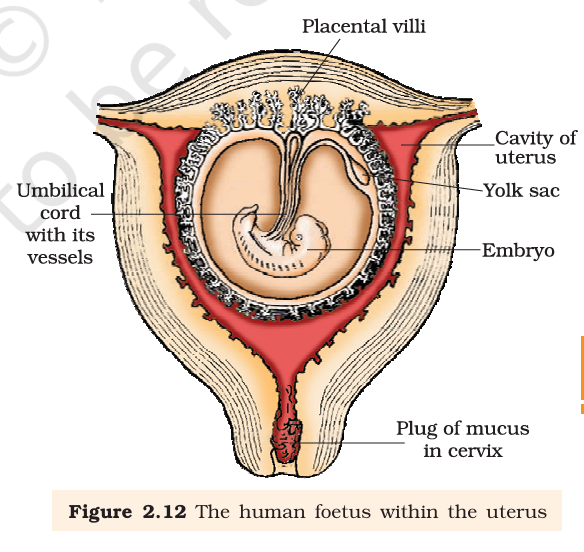
“After implantation, chorionic villi from the trophoblast interdigitate with uterine tissue to form the placenta — the structural & functional link between foetus and mother, connected by the umbilical cord.”

Figure 2.12 The human foetus within the uterus
🧒 Explain like I’m 10

Tiny finger-like roots (chorionic villi) grow into the womb wall and join with it to make the placenta — the 'lifeline' between baby and mother, joined by the umbilical cord (the tummy rope).

❓ 11 NEET-style questions to master this line
  1. Finger-like projections on the trophoblast are called ____.
    Show answerChorionic villi.
  2. The structural & functional unit between foetus and mother is the ____.
    Show answerPlacenta.
  3. The placenta connects to the embryo through the ____.
    Show answerUmbilical cord.
  4. Name two functions of the placenta.
    Show answerSupply O2 & nutrients; remove CO2 & wastes (also endocrine).
  5. Chorionic villi are surrounded by uterine tissue and ____.
    Show answerMaternal blood.
  6. From which embryonic structure do chorionic villi arise?
    Show answerTrophoblast.
  7. Function of chorionic villi?
    Show answerTo interdigitate with maternal endometrium and form the placenta.
  8. Two main functions of the placenta?
    Show answerFacilitates supply of O₂ and nutrients; removal of CO₂ and waste.
  9. What is the umbilical cord?
    Show answerA connecting structure between foetus and placenta carrying foetal blood vessels.
  10. Is maternal and foetal blood normally separate?
    Show answerYes — the placenta keeps them separate while allowing exchange.
  11. Number of blood vessels in the umbilical cord?
    Show answerTwo arteries and one vein (three vessels).
26

“The placenta is also an endocrine tissue producing hCG, hPL, estrogens and progestogens; relaxin is secreted by the ovary in late pregnancy. hCG, hPL and relaxin are produced ONLY during pregnancy.”

🧒 Explain like I’m 10

The placenta also works like a hormone factory, making several hormones. A few hormones — hCG, hPL and relaxin — appear only when a woman is pregnant.

❓ 11 NEET-style questions to master this line
  1. Name two hormones produced by the placenta.
    Show answerhCG, hPL, estrogens, progestogens (any two).
  2. Which hormone is secreted by the ovary in late pregnancy?
    Show answerRelaxin.
  3. Which hormones are produced only during pregnancy?
    Show answerhCG, hPL and relaxin.
  4. hCG stands for ____.
    Show answerHuman chorionic gonadotropin.
  5. hPL stands for ____.
    Show answerHuman placental lactogen.
  6. What does hCG stand for?
    Show answerHuman chorionic gonadotropin.
  7. What does hPL stand for?
    Show answerHuman placental lactogen.
  8. Which placental hormone is detected by pregnancy tests?
    Show answerhCG.
  9. Which hormone helps soften the pelvic ligaments near term?
    Show answerRelaxin.
  10. Source of relaxin in late pregnancy?
    Show answerThe ovary (corpus luteum).
  11. Are hCG, hPL and relaxin produced in non-pregnant women?
    Show answerNo — they are produced only during pregnancy.
27

“The inner cell mass differentiates into ectoderm, mesoderm and endoderm (the three germ layers giving rise to all tissues); it contains stem cells. Human pregnancy lasts ~9 months: heart by 1 month, limbs & digits by 2 months, major organs & genitalia by 12 weeks, movements & head hair by 5 months, body hair/eyelids/lashes by 24 weeks.”

🧒 Explain like I’m 10

The inner cell clump forms three layers that build the whole body, and it holds powerful 'stem cells'. Pregnancy lasts about 9 months: heart at 1 month, arms & fingers at 2 months, and so on, until the baby is fully ready.

❓ 11 NEET-style questions to master this line
  1. Name the three germ layers.
    Show answerEctoderm, mesoderm, endoderm.
  2. Cells with the potency to form all tissues are ____.
    Show answerStem cells.
  3. By which month is the embryo's heart formed?
    Show answerFirst month.
  4. By the end of which period are most major organ systems formed?
    Show answer12 weeks (first trimester).
  5. When are the first foetal movements & head hair noticed?
    Show answerFifth month.
  6. Name the three primary germ layers.
    Show answerEctoderm, mesoderm and endoderm.
  7. By which month is the foetal heart formed?
    Show answer1 month.
  8. Limbs and digits appear by which month?
    Show answer2 months.
  9. By 12 weeks, what is largely formed?
    Show answerMajor organs and external genitalia.
  10. Body hair, eyelids and lashes appear by approximately?
    Show answer24 weeks.
  11. Total duration of human pregnancy?
    Show answerAbout 9 months (~38–40 weeks).
2.7

Parturition & Lactation

28

“Gestation lasts ~9 months. Parturition (childbirth) is induced by a neuroendocrine mechanism: signals from the foetus & placenta cause the foetal ejection reflex → oxytocin release from the maternal pituitary → stronger uterine contractions (a positive feedback loop) → expulsion of the baby; the placenta is expelled soon after.”

🧒 Explain like I’m 10

After about 9 months, the baby is pushed out — this is parturition. The fully-grown baby and placenta send a signal that triggers oxytocin from the mother's brain, which makes the womb squeeze harder and harder until the baby is born.

❓ 11 NEET-style questions to master this line
  1. The period of pregnancy is called the ____ period.
    Show answerGestation.
  2. The process of childbirth is called ____.
    Show answerParturition.
  3. The mild uterine contractions triggered by foetal/placental signals are the ____.
    Show answerFoetal ejection reflex.
  4. Which hormone from the maternal pituitary causes strong uterine contractions?
    Show answerOxytocin.
  5. What is expelled soon after the infant is delivered?
    Show answerThe placenta.
  6. Define parturition.
    Show answerThe vigorous, coordinated process of childbirth.
  7. What initiates the foetal ejection reflex?
    Show answerSignals from the fully-developed foetus and the placenta.
  8. Which hormone causes strong uterine contractions during labour?
    Show answerOxytocin (released from maternal posterior pituitary).
  9. Type of feedback that strengthens labour contractions?
    Show answerPositive feedback.
  10. What is expelled after the baby during parturition?
    Show answerThe placenta (afterbirth).
  11. Define gestation.
    Show answerThe period from fertilisation to parturition (~9 months in humans).
29

“Mammary glands differentiate during pregnancy and produce milk (lactation). The first milk, colostrum, contains antibodies essential for the newborn's immunity; breast-feeding in early infancy is recommended.”

🧒 Explain like I’m 10

During pregnancy the breasts get ready to make milk. The very first milk (colostrum) is full of germ-fighting antibodies — like a free vaccine — so doctors strongly recommend breastfeeding.

❓ 11 NEET-style questions to master this line
  1. The process of milk production is called ____.
    Show answerLactation.
  2. The first milk produced after birth is called ____.
    Show answerColostrum.
  3. Why is colostrum important for the newborn?
    Show answerIt contains antibodies that build resistance/immunity.
  4. When do mammary glands start producing milk?
    Show answerTowards the end of pregnancy.
  5. What do doctors recommend during early infant growth?
    Show answerBreast-feeding.
  6. What is colostrum?
    Show answerThe first milk secreted after parturition, rich in antibodies.
  7. Which antibody class is mainly found in colostrum?
    Show answerIgA (immunoglobulin A).
  8. Why is colostrum important for the newborn?
    Show answerProvides passive immunity to the infant.
  9. Term for milk production by mammary glands?
    Show answerLactation.
  10. Time during pregnancy when mammary glands fully differentiate?
    Show answerDuring pregnancy (preparing for post-parturition lactation).
  11. Recommended duration of exclusive breast-feeding by WHO?
    Show answerAbout the first 6 months of infancy.

Exceptions to Remember

🧪

Scientists / Source of Each Secretion

Note on this chapter

NCERT Ch.2 (Human Reproduction) is descriptive and does not credit discoveries to named individual scientists. So instead of person-names, NEET tests the source of each hormone/secretion — listed below.

Hypothalamus

Secretes GnRH, which triggers the whole reproductive hormone cascade.

Anterior Pituitary

Secretes the gonadotropins LH & FSH (and prolactin).

Leydig (interstitial) cells

Secrete androgens (testosterone).

Sertoli cells

Provide nutrition to germ cells; secrete factors aiding spermiogenesis (under FSH).

Corpus luteum

Secretes progesterone (maintains endometrium).

Placenta

Secretes hCG, hPL, estrogens, progestogens; ovary secretes relaxin in late pregnancy.

📌

Key Examples & Values in the Chapter

Example / ValueSignificance
Monkeys, apes, humansFemale primates that show the menstrual cycle.
Fructose, calcium, enzymesComponents of seminal plasma.
hCG, hPL, estrogens, progestogensHormones secreted by the placenta.
RelaxinSecreted by the ovary in late pregnancy.
ColostrumFirst milk — rich in antibodies for the newborn.
Ectoderm, mesoderm, endodermThree germ layers from the inner cell mass.
200–300 million spermsReleased per ejaculation (≥60% normal, ≥40% motile).
60,000–80,000 primary folliclesRemaining per ovary at puberty.
28/29 daysAverage length of the human menstrual cycle.
~14th dayLH surge & ovulation in a 28-day cycle.
~9 monthsHuman gestation period.
📝

NCERT Textbook Exercises – Explained & Answered

Q1Fill in the blanks: (a) Humans reproduce ___ (b) Humans are ___ (c) Fertilisation is ___ (d) Gametes are ___ (e) Zygote is ___ (f) Release of ovum from a mature follicle is ___ (g) Ovulation is induced by ___ (h) Fusion of gametes is ___ (i) Fertilisation takes place in ___ (j) Zygote forms ___ implanted in uterus (k) Vascular connection between foetus & uterus is ___

🧒 What it’s really asking

Complete each blank with the right reproduction term.

Show answer
(a) sexually (b) viviparous (c) internal (d) haploid (e) diploid (f) ovulation (g) LH (LH surge) (h) fertilisation/syngamy (i) ampulla of the fallopian tube (j) blastocyst (k) placenta.

Q2Write two major functions each of the testis and the ovary.

🧒 What it’s really asking

What two big jobs does each main organ do?

Show answer
Testis: (i) produces sperms (spermatogenesis); (ii) secretes male hormones (androgens, via Leydig cells). Ovary: (i) produces ova (oogenesis); (ii) secretes ovarian steroid hormones (estrogen, progesterone).

Q3Describe the structure of a seminiferous tubule.

🧒 What it’s really asking

What is a sperm-making tube made of?

Show answer
Each seminiferous tubule is lined internally by two cell types: spermatogonia (male germ cells) that divide to form sperms, and Sertoli cells that nourish the germ cells. The surrounding interstitial spaces have Leydig cells (secrete androgens) and blood vessels.

Q4What is spermatogenesis? Briefly describe the process.

🧒 What it’s really asking

How are sperm made, step by step?

Show answer
Spermatogenesis is the formation of sperms from spermatogonia. Spermatogonia (46) → mitosis → primary spermatocyte → meiosis I → 2 secondary spermatocytes (23) → meiosis II → 4 spermatids → spermiogenesis → spermatozoa → released by spermiation.

Q5Name the hormones involved in the regulation of spermatogenesis.

🧒 What it’s really asking

Which hormones control sperm-making?

Show answer
GnRH (hypothalamus) → FSH and LH (anterior pituitary). LH → Leydig cells → androgens; FSH → Sertoli cells.

Q6Define spermiogenesis and spermiation.

🧒 What it’s really asking

Two similar-sounding sperm words — what's the difference?

Show answer
Spermiogenesis: transformation of spermatids into mature spermatozoa (sperms). Spermiation: release of mature sperms from the seminiferous tubules.

Q7What are the major components of seminal plasma?

🧒 What it’s really asking

What's in the fluid that carries sperm?

Show answer
Seminal plasma (secreted by accessory glands) is rich in fructose, calcium and certain enzymes.

Q8What are the major functions of male accessory ducts and glands?

🧒 What it’s really asking

What do the male tubes and glands do?

Show answer
Ducts (rete testis, vasa efferentia, epididymis, vas deferens) store and transport sperms. Glands (seminal vesicles, prostate, bulbourethral) secrete seminal plasma for nutrition, maturation, motility and lubrication.

Q9What is oogenesis? Give a brief account.

🧒 What it’s really asking

How are eggs made?

Show answer
Oogenesis is the formation of the mature female gamete. Oogonia form in the fetal ovary → primary oocytes arrest at prophase-I → at puberty follicles mature (primary→secondary→tertiary→Graafian); the primary oocyte completes meiosis I → secondary oocyte + first polar body; meiosis II completes only after fertilisation.

Q10Name the functions of: (a) Corpus luteum (b) Endometrium (c) Acrosome (d) Sperm tail (e) Fimbriae.

🧒 What it’s really asking

What does each of these parts do?

Show answer
(a) Corpus luteum – secretes progesterone to maintain endometrium. (b) Endometrium – uterine lining for implantation; sheds in menstruation. (c) Acrosome – enzymes to penetrate the ovum. (d) Sperm tail – motility/swimming. (e) Fimbriae – collect the ovum after ovulation.

Q11True/False (correct the false ones): (a) Androgens are produced by Sertoli cells (b) Spermatozoa get nutrition from Sertoli cells (c) Leydig cells are found in ovary (d) Leydig cells synthesise androgens (e) Oogenesis takes place in corpus luteum (f) Menstrual cycle ceases during pregnancy (g) Hymen is not a reliable indicator of virginity.

🧒 What it’s really asking

Spot the false statements and fix them.

Show answer
(a) False – androgens are made by Leydig cells. (b) True. (c) False – Leydig cells are in the testis. (d) True. (e) False – oogenesis occurs in the ovary. (f) True. (g) True.

Q12What is the menstrual cycle? Which hormones regulate it?

🧒 What it’s really asking

What is the monthly cycle, and what controls it?

Show answer
The menstrual cycle is the ~28/29-day reproductive cycle of female primates (menstrual → follicular → ovulatory → luteal phases). Regulated by pituitary hormones (FSH, LH) and ovarian hormones (estrogen, progesterone).

Q13What is parturition? Which hormones induce it?

🧒 What it’s really asking

What is childbirth, and what hormones drive it?

Show answer
Parturition is the process of childbirth (delivery of the foetus). It is induced by a neuroendocrine mechanism involving the foetal ejection reflex and oxytocin (with cortisol and estrogens).

Q14In society women are often blamed for giving birth to daughters. Explain why this is incorrect.

🧒 What it’s really asking

Why is it wrong to blame the mother for a girl baby?

Show answer
Because the father determines the sex. The ovum always carries X; sperms carry X or Y. An X-sperm gives XX (girl) and a Y-sperm gives XY (boy). The mother only ever contributes X, so she cannot decide the sex.

Q15How many eggs are released by a human ovary in a month? For identical twins? For fraternal twins?

🧒 What it’s really asking

Counting eggs: one baby vs two kinds of twins.

Show answer
Normally one ovum per month. Identical twins: still one egg (it splits after fertilisation). Fraternal twins: two eggs (released and fertilised separately) — so yes, the answer changes.

Q16How many eggs were released by a female dog that gave birth to 6 puppies?

🧒 What it’s really asking

If a dog had 6 puppies, how many eggs?

Show answer
At least 6 eggs (one fertilised egg per puppy, assuming none are identical).

High-Yield Points (Last-Minute Revision)

  1. Scrotum keeps testes 2–2.5°C below body temp. Each testis ≈ 250 lobules, each with 1–3 seminiferous tubules.
  2. Tubule lining = spermatogonia + Sertoli cells (nutrition); Leydig cells (interstitial) → androgens.
  3. Male duct order: rete testis → vasa efferentia → epididymis → vas deferens → ejaculatory duct → urethra.
  4. Seminal plasma: fructose, calcium, enzymes. Semen = seminal plasma + sperms.
  5. Oviduct: infundibulum (fimbriae) → ampulla → isthmus. Uterus layers: perimetrium, myometrium, endometrium.
  6. Spermatogenesis: spermatogonium(46) →mitosis→ 1° spermatocyte →meiosis I→ 2× 2° spermatocyte(23) →meiosis II→ 4 spermatids →spermiogenesis→ sperm →spermiation.
  7. Hormones: GnRH→FSH+LH; LH→Leydig→androgens; FSH→Sertoli.
  8. Sperm: head (nucleus + acrosome), middle piece (mitochondria), tail. 200–300 M/ejaculate; ≥60% normal, ≥40% motile.
  9. Oogenesis: oogonia in fetal ovary (none after birth); 1° oocyte arrests at prophase-I; 60,000–80,000 follicles/ovary at puberty.
  10. Follicles: primary→secondary→tertiary(antrum, theca interna/externa)→Graafian. Meiosis I → 2° oocyte + 1st polar body. Zona pellucida.
  11. Menstrual cycle (28/29 d): menstrual(3–5 d) → follicular → LH surge ~day 14 → ovulation → luteal (corpus luteum → progesterone). Menarche → menopause(~50).
  12. Fertilisation in ampulla; zona pellucida blocks polyspermy; acrosome enzymes; meiosis II completes → ootid + 2nd polar body → diploid zygote.
  13. Sex determined by father (X/Y sperm). Cleavage → blastomeres → morula (8–16)blastocyst (trophoblast + inner cell mass)implantation.
  14. Placenta: O2/nutrient & waste exchange + endocrine (hCG, hPL, estrogen, progesterone); relaxin from ovary. hCG/hPL/relaxin only in pregnancy.
  15. Germ layers: ectoderm, mesoderm, endoderm. Milestones: heart 1 mo, limbs 2 mo, organs 12 wk, movements/hair 5 mo, body hair/eyelids 24 wk, ready 9 mo.
  16. Parturition: foetal ejection reflex → oxytocin (positive feedback). Lactation: first milk = colostrum (antibodies).

Faculty Exam Pack — High-Yield NEET Material

Curated by exam-pattern analysis (NTA/AIPMT style) — strictly from the NCERT Human Reproduction text. Built for rapid revision and MCQ accuracy.

1 The NEET Cheat Sheet — Ploidy, Terminology & Pathways

Sperm transport pathway

Seminiferous tubulesRete testisVasa efferentiaEpididymisVas deferensEjaculatory ductUrethraUrethral meatus

Ovum transport pathway

Ovary (ovulation)FimbriaeInfundibulumAmpulla (fertilisation)IsthmusUterus

Ploidy map — Spermatogenesis

Cell stagePloidyChromosomes
Spermatogonium (germ cell)2n46
Primary spermatocyte2n46
Secondary spermatocyte (after Meiosis I)n23
Spermatid (after Meiosis II)n23
Spermatozoon (sperm)n23

Ploidy map — Oogenesis

Cell stagePloidyChromosomes
Oogonium2n46
Primary oocyte (arrested in prophase-I)2n46
Secondary oocyte (after Meiosis I)n23
First polar bodyn23
Ootid / Ovum (after Meiosis II)n23
Second polar bodyn23
  • Spermatogenesis — the whole process of sperm formation from spermatogonia, including mitosis & meiosis (spermatogonium → spermatid).
  • Spermiogenesis — the transformation of non-motile spermatids into mature, motile spermatozoa (a shape/structural change; no division).
  • Spermiation — the release of mature sperms from the seminiferous tubules (sperm heads detach from Sertoli cells).

2 Hormone Mapping & Fetal Milestones

Hormones across the 4 phases of the menstrual cycle

1

Menstrual phase

Day 1–5
FSHLow
LHLow
EstrogenLow
ProgesteroneLow

Endometrium and its blood vessels break down → menstrual flow. Occurs only if the ovum was not fertilised.

2

Follicular / Proliferative

Day 6–13
FSH↑ Rising
LH↑ Rising
Estrogen↑ Rising
ProgesteroneLow

Primary follicles mature into a Graafian follicle; endometrium regenerates by proliferation. Estrogen is secreted by the growing follicles.

3

Ovulatory

~Day 14
FSH● Peak
LH● LH SURGE
EstrogenHigh
ProgesteroneLow

The rapid mid-cycle LH surge ruptures the Graafian follicle → ovulation (release of the secondary oocyte).

4

Luteal / Secretory

Day 15–28
FSH↓ Falling
LH↓ Falling
EstrogenModerate
Progesterone● High

Corpus luteum secretes progesterone → maintains the endometrium. No fertilisation → corpus luteum degenerates → progesterone falls → menstruation (new cycle).

⚡ Ovulation trigger

The mid-cycle LH surge (~Day 14) ruptures the Graafian follicle.

🩸 Menstruation trigger

No fertilisation → corpus luteum degenerates → progesterone falls → endometrium breaks down.

🫧 Made by the placenta

hCG, hPL, estrogens, progestogens.

🤰 Only during pregnancy

hCG, hPL, Relaxin (relaxin from the ovary, late pregnancy). Also raised: estrogens, progestogens, cortisol, prolactin, thyroxine.

Fetal development milestones (as stated in NCERT)

  • End of 1 monthEmbryo's heart is formed (first detectable sign via stethoscope).
  • End of 2 monthsFoetus develops limbs and digits.
  • End of 12 weeks (1st trimester)Most major organ systems formed; limbs & external genital organs well-developed.
  • 5th monthFirst movements of the foetus; hair on the head appears.
  • End of 24 weeks (2nd trimester)Body covered with fine hair; eye-lids separate; eyelashes formed.

3 The “Trap Avoidance” Guide

  • “Ovum” vs “Secondary oocyte”: the ovary releases a secondary oocyte (still arrested in Meiosis II), NOT a fully mature ovum. NTA loves the option “ovum is released at ovulation” — it is technically a secondary oocyte.
  • When is Meiosis II completed in females? ONLY after a sperm enters the secondary oocyte (at fertilisation), producing the second polar body + the ootid/ovum. It is never completed before fertilisation.
  • Seminal plasma composition: rich in fructose, calcium and enzymes — NOT glucose, NOT sucrose. Reject any option substituting these.
  • Leydig vs Sertoli: Leydig = androgens; Sertoli = nutrition (FSH target). Swapping these is the single most common trap.

4 High-Yield Practice MCQs

10 NTA-pattern questions — 3 factual, 2 sequence, 3 statement-based, 2 assertion–reason. Tap “Show answer & why options fail”.

StandardQ1. The acrosome of a human sperm is filled with:

  1. Mitochondria for energy
  2. Enzymes that help fertilisation of the ovum
  3. A haploid nucleus
  4. Sex chromosomes
Show answer & why options failAnswer: (b) Enzymes that help fertilisation of the ovum
The acrosome is a cap over the sperm head filled with enzymes that help the sperm penetrate the ovum. (a) Mitochondria are in the middle piece, not acrosome. (c) The nucleus is in the head, separate from the acrosomal cap. (d) Sex chromosomes lie within the nuclear DNA, not the acrosome.

StandardQ2. The scrotum maintains the temperature of the testes at:

  1. The same as body temperature
  2. 2–2.5°C higher than body temperature
  3. 2–2.5°C lower than body temperature
  4. 5°C lower than body temperature
Show answer & why options failAnswer: (c) 2–2.5°C lower than body temperature
NCERT states the scrotum keeps the testes 2–2.5°C lower than normal internal body temperature — necessary for spermatogenesis. Higher/equal temperature would impair sperm formation; 5°C is not stated.

StandardQ3. Which cells synthesise and secrete androgens?

  1. Sertoli cells
  2. Spermatogonia
  3. Leydig (interstitial) cells
  4. Germ cells
Show answer & why options failAnswer: (c) Leydig (interstitial) cells
Leydig cells in the interstitial spaces secrete androgens. (a) Sertoli cells provide nutrition to germ cells (a classic NTA swap). (b)/(d) Germ cells/spermatogonia divide to form sperms, they do not make hormones.

SequenceQ4. Arrange the correct path of sperm transport through the male ducts:

  1. Vas deferens → epididymis → rete testis → vasa efferentia → urethra
  2. Rete testis → vasa efferentia → epididymis → vas deferens → ejaculatory duct → urethra
  3. Vasa efferentia → rete testis → vas deferens → epididymis → urethra
  4. Epididymis → rete testis → vasa efferentia → vas deferens → urethra
Show answer & why options failAnswer: (b) Rete testis → vasa efferentia → epididymis → vas deferens → ejaculatory duct → urethra
Correct order: seminiferous tubules → rete testis → vasa efferentia → epididymis → vas deferens → ejaculatory duct → urethra. All other options jumble the rete testis/vasa efferentia/epididymis order.

SequenceQ5. Starting from the ovary, arrange the parts an ovum passes through:

  1. Ampulla → infundibulum → isthmus → uterus
  2. Isthmus → ampulla → infundibulum → uterus
  3. Infundibulum (fimbriae) → ampulla → isthmus → uterus
  4. Infundibulum → isthmus → ampulla → uterus
Show answer & why options failAnswer: (c) Infundibulum (fimbriae) → ampulla → isthmus → uterus
After ovulation the fimbriae of the infundibulum collect the ovum → ampulla (site of fertilisation) → isthmus → uterus. Option (a)/(b)/(d) misplace the ampulla or isthmus.

StatementQ6. How many of the following statements are CORRECT?
(i) Sertoli cells secrete androgens. (ii) Fertilisation occurs in the ampulla. (iii) Oogonia are formed in the fetal ovary and not after birth. (iv) Seminal plasma is rich in fructose, calcium and enzymes.

  1. One
  2. Two
  3. Three
  4. Four
Show answer & why options failAnswer: (c) Three
Three are correct: (ii), (iii), (iv). Statement (i) is WRONG — androgens are secreted by Leydig cells; Sertoli cells only provide nutrition.

StatementQ7. How many of the following are produced ONLY during pregnancy?
hCG, hPL, Relaxin, FSH, Progesterone

  1. Two
  2. Three
  3. Four
  4. Five
Show answer & why options failAnswer: (b) Three
ThreehCG, hPL and Relaxin are produced only during pregnancy (relaxin from the ovary in late pregnancy). FSH and progesterone are present in non-pregnant cycles too, so they don't count.

StatementQ8. Consider: (i) The first menstruation is menarche. (ii) Menstrual cycle ceases during pregnancy. (iii) Only one ovum is released per cycle. (iv) The LH surge triggers menstruation. How many are correct?

  1. One
  2. Two
  3. Three
  4. Four
Show answer & why options failAnswer: (c) Three
Three correct: (i), (ii), (iii). Statement (iv) is WRONG — the LH surge triggers ovulation, not menstruation; menstruation is triggered by degeneration of the corpus luteum (fall in progesterone).

Assertion–ReasonQ9. Assertion (A): The sex of the baby is determined by the father.
Reason (R): The ovum always carries an X chromosome, while sperms may carry either X or Y.

  1. Both A and R are true and R is the correct explanation of A
  2. Both A and R are true but R is NOT the correct explanation of A
  3. A is true but R is false
  4. A is false but R is true
Show answer & why options failAnswer: (a) Both A and R are true and R is the correct explanation of A
Both are true and R correctly explains A. Since the ovum is always X, the X/Y of the fertilising sperm decides XX (girl) or XY (boy) — so the father determines sex.

Assertion–ReasonQ10. Assertion (A): Menstruation does not occur during pregnancy.
Reason (R): The corpus luteum persists and secretes progesterone which maintains the endometrium.

  1. Both A and R are true and R is the correct explanation of A
  2. Both A and R are true but R is NOT the correct explanation of A
  3. A is true but R is false
  4. A is false but R is true
Show answer & why options failAnswer: (a) Both A and R are true and R is the correct explanation of A
Both true; R explains A. Maintained progesterone (corpus luteum, later placenta) keeps the endometrium intact, so it is not shed — hence no menstruation during pregnancy.